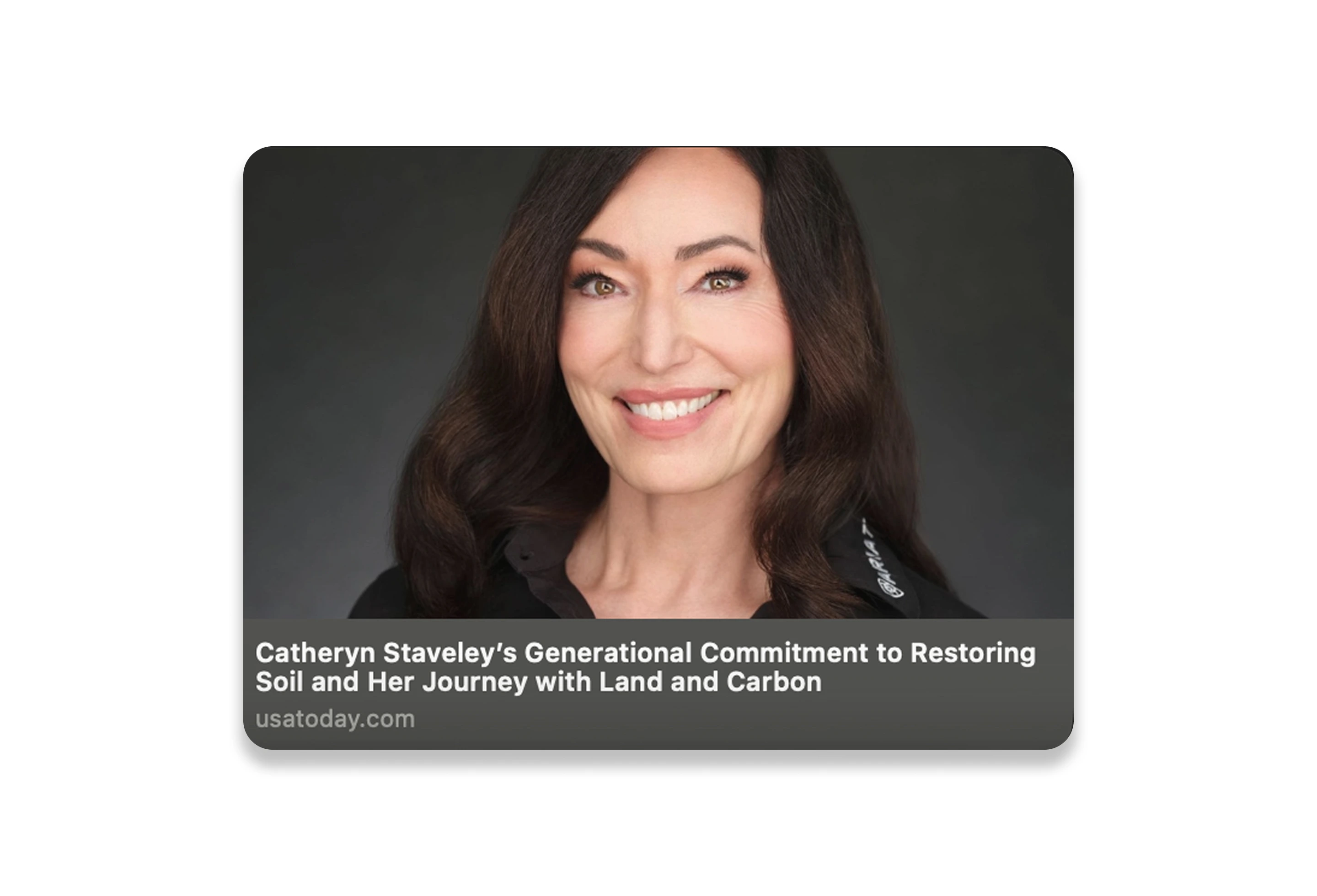
Catheryn Staveley’s work with Land and Carbon reflects a commitment to restoring land through science‑informed methods that remain grounded in the lived experience of farmers and ranchers. Her role blends professional focus with personal history, shaped by a lifelong connection to rural landscapes and the people who depend on them.
That connection traces back to her upbringing in Alberta, Canada, where wide‑open rangeland shaped daily life and informed her earliest understanding of responsibility to the land. “On our family ranch, I learned early on that the land supported us in many ways. It helped me see how resilient the land is and how fragile life on the land can be. That stayed with me,” she shares. Those early lessons continue to guide how she approaches stewardship today, framing it as both an opportunity and an obligation.
According to Staveley, the family ranch now serves as an anchor project for Land and Carbon’s work, creating a direct link between past generations and the organization’s present efforts. The land carries decades of family history, and the project reflects a commitment to strengthening its long‑term health. As the work progresses, community involvement has become central, with neighbors contributing insight and support, much like they did during her childhood.
Exploring the countryside on horseback also revealed the realities of agricultural work. “My dad would remind us that the land was something we could always return to, and that shaped how I understood the work happening around me,” she says. “Seeing the level of care required in day‑to‑day tasks made that message even clearer. It showed me how difficult and unforgiving a life lived off the land can be.”
Her father’s influence continues to shape her perspective. Known for steady encouragement, he instilled a belief in perseverance and forward movement, qualities she carries into her work today.
As Staveley moved into her professional life, those early lessons naturally informed the direction of her career. She began in environmental engineering before transitioning into the energy sector. She gained experience across operations, fieldwork, and project development. Over time, her focus shifted toward nature-based carbon sequestration. This transition brought her closer to the questions she had considered since childhood, including how land can be managed in ways that support both ecosystems, livelihoods, and the environment.
A formative chapter in that journey involved work in plant‑based carbon research. “As I spent more time working with soil and carbon research, I started to see how these natural systems can recover when the right conditions are in place,” she states. It allowed her to bridge academic insight with practical application, reinforcing the idea that science and lived experience can strengthen one another.
This perspective led her to help build Land and Carbon alongside Dr. David Lawrence, founder, chairman, and CEO. The organization grew from a shared belief that removing CO₂ from the atmosphere can help restore the land, guided by rigorous science and grounded in respect for the expertise of those who work the land every day. Its model integrates soil science, regenerative practices, and long‑term monitoring, tailored to the conditions of each site.
From the beginning, engagement with landowners shaped the company’s direction. “We’ve seen how much insight farmers and ranchers bring to this work. Their experience shapes every decision we make, and it’s important to build projects with them, not just for them,” Staveley says. Her background enables her to connect with landowners through open dialogue and collaborative problem-solving. Staveley notes that the company’s model also recognizes the financial realities many partners face, offering support that may help make early-stage participation more manageable and aligned with current priorities.
This collaborative approach extends into Innovation Sites™, smaller sections within larger properties, where new practices are tested in partnership with landowners. These sites may create opportunities to evaluate methods under real conditions while inviting participation from the broader community. Over time, Staveley notes, emerging results can help strengthen confidence and guide decisions across a range of landscapes.
This generational lens also shapes how Staveley views the broader connection between people and the land. Over 90% of the food people rely on begins with soil, yet the process behind it often remains unseen. Staveley hopes to support greater awareness of that connection and a deeper appreciation for the work involved in bringing food from the ground to everyday life. For her, restoring land is not only about outcomes but also about honoring the people, legacies, and communities that depend on it.
Overall, Catheryn Staveley’s work today reflects a balance between technical knowledge and personal conviction. Through Land and Carbon, she aims to contribute to a model that brings together science, collaboration, and respect for the land’s history. She sees each project as unique, shaped by the people involved and the characteristics of the landscape.